Custom Hydraulic Press Capabilities
Hydraulic Press Capabilities
When your application doesn’t fit a catalog, you need a manufacturer that builds from scratch, not one that bends a standard press until it almost works. Savage Engineering’s hydraulic press capabilities span the full spectrum of industrial pressing applications, from straightening and metal forming to powder compaction and compression molding. Every press we build is engineered to your exact process requirements, with capacities ranging up to 3,500 tons. If you’ve been told it can’t be done, it’s worth a conversation with us.
One Roof, One Team, One Accountable Party
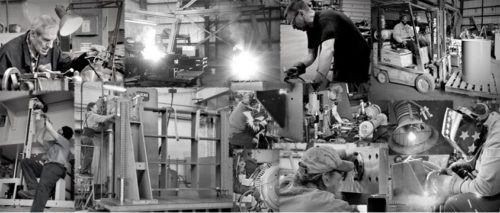
When engineering, fabrication, electrical, hydraulics, and controls all happen in the same building under the same roof, things go differently than when they’re split across multiple vendors. The engineer who designed your press is on the same floor as the machinist cutting the frame and the electrician wiring the panel. Questions get answered in person. Changes during a build don’t require a change order to a subcontractor.
Our in-house capabilities include:
- Concept-specific engineering and design
- Full machine shop machining
- Structural welding and fabrication
- Electrical design and control panel building
- Hydraulic design and pipe-fitting
- PLC programming and HMI configuration
- Custom paint and finishing
- Factory acceptance testing and production run-off
- Rigging and shipping
60+ Years Of Challenges Met
Savage Engineering began life as a custom hydraulic press manufacturer in 1963, when Fred Wolbert built purpose-built presses for the construction equipment industry, starting with track pin presses for bulldozer repair. In the first year alone, he designed, built, and sold more than 30. The company grew from there by taking on the applications that didn’t fit a catalog: jobs where the process was unusual, the tolerances were tight, or the materials were difficult.
That history shows up in the range of problems we’ve solved. Savage has built presses for superplastic forming of titanium and aluminum at temperatures up to 1,800°F, compaction of explosive powders for defense applications, hot forging of optical crystals and lenses, mounting and demounting railcar wheels and axles, and sizing frozen food products. These aren’t applications where you call a catalog supplier. They require hydraulic press engineering services grounded in first-principles thinking about what the process actually demands.
Every design starts with a stress analysis to confirm structural integrity before fabrication begins. Frame materials, including chrome tie rod ends, elongated brass bushings, and heavy steel weldments, are selected for the demands of the application, and Savage’s press frames carry a lifetime structural guarantee.
Industrial Press Solutions
Savage builds across the full range of frame configurations and press types, matched to the application:
- 4-post presses: compression molding, drawing, and deep drawing
- Straight-side presses: rugged and demanding forming applications, available with pre-stressed housing
- C-frame presses: forming, assembly, molding; available in guided, unguided, and straightening models
- Traveling gantry straightening presses: bar, tube, and plate straightening, both narrow bed and wide bed configurations
- Die spotting presses: die and mold spotting and try-out, including swing-out platen models
- Opposed ram compaction presses: powder and explosives compaction
- Cold header die repair presses: pressing carbide inserts into and out of cold header dies
- Horizontal forcing presses: pressing wheels, sheaves, gears, and similar components onto and off of shafts and axles
- Hot presses: superplastic forming, internal pressure forming, heat bonding
- Specialty and assembly presses: electric motor assembly systems, pulley splitting, staking, riveting
The industries we serve reflect that range. Examples include:
- Automotive
- Aerospace
- Defense
- Railroad
- Heavy manufacturing
- Metal forming
- Composites
- Plastics
- Food processing
Frequently Asked Questions: Hydraulic Press Capabilities
How do I know whether I need a custom press or whether a standard model will work?
If your application has unusual materials, tight tolerances, non-standard bed dimensions, specific stroke or daylight requirements, or process conditions (like elevated temperature or hazardous materials) that a catalog press wasn’t designed for, you likely need a custom build. The faster answer: call Savage and describe the process. If a standard configuration can handle it, we’ll tell you. If it can’t, we’ll tell you that, too.
What happens during factory acceptance testing?
Before your press ships, it’s tested at Savage’s facility in Garfield Heights, Ohio, under actual operating conditions. All hydraulic, electrical, and control systems undergo a full functional check and a production runoff. You’re welcome and encouraged to witness the runoff. It’s the point at which you can confirm the machine performs to spec before it leaves the building.
Does Savage offer on-site support after installation?
On-site installation and operator training are available. Beyond that, technical support is provided at no charge for the life of the press. That’s not a limited warranty window; it’s an ongoing relationship. If something comes up years down the road, Savage is still the right call.
In-House Capabilities
- Concept-Specific Engineering and Design
- Machining with Full Machine Shop Capabilities
- Welding
- Fabrication
- Machine Construction
- Electrical design and panel building
- Hydraulic design and pipe-fitting
- PLC Programming
- Custom paint
- Factory Acceptance Testing and Run-Off
- Rigging and Shipping
Associations
- BBB A+ Business
- NAM, PMA, ACMA Member
- Dunn & Bradstreet